---
title: "How SCA Helps Manage OSS Vulnerabilities"
description: "Explore how Software Composition Analysis (SCA) helps teams manage open source software vulnerabilities."
canonical_url: "https://fossa.com/blog/how-sca-helps-manage-oss-vulnerabilities/"
markdown_url: "https://fossa.com/blog/how-sca-helps-manage-oss-vulnerabilities.md"
content_type: "blog"
language: "en"
date_published: "2021-04-16"
date_modified: "2021-04-16"
author: "Andy Drukarev"
organization: "FOSSA"
---
# How SCA Helps Manage OSS Vulnerabilities
> Explore how Software Composition Analysis (SCA) helps teams manage open source software vulnerabilities.
Before we dive into the specifics of [software composition analysis](https://fossa.com/complete-guide-software-composition-analysis) (SCA) helps teams manage open source software (OSS) vulnerabilities, it’s important to understand just how widespread OSS is in our modern world of application development.
A few eye-opening data points tell the story:
- More than [90%](https://www.infoworld.com/article/3245308/rethinking-your-open-source-use-policy.html) of modern applications use at least some open source software
- The average application uses [147 different](https://www.csoonline.com/article/3157377/open-source-software-security-challenges-persist.html) open source components
- Open source vulnerabilities [continue to rise](https://www.infosecurity-magazine.com/news/open-source-vulnerabilities/) year over year
With this backdrop, it’s no surprise that a growing number of organizations have implemented [software composition analysis tools](https://fossa.com/blog/framework-for-evaluating-software-composition-analysis-tools.md) to help manage OSS vulnerabilities. SCA enables organizations to identify, analyze, and control risk (of the license compliance, security, and quality nature) in the open source components of their codebase. In this blog, we’ll examine one category of risk — security — and how, exactly, SCA tools help organizations manage OSS vulnerabilities.
> RELATED:
>
> The Complete Guide to Software Supply Chain Security
>
## SCA Helps Inventory OSS Dependencies
The road to managing OSS vulnerabilities starts with a comprehensive and accurate inventory of _your_ dependencies. After all, an organization can’t address vulnerabilities without understanding all of the components in its codebase. But, given the volume of open source in modern applications (not to mention the breadth of different programming languages), this can be easier said than done.
Software composition analysis provides this inventory by scanning your codebase and providing essentially a comprehensive [software bill of materials](https://fossa.com/blog/software-bill-of-materials-formats-use-cases-tools/) — i.e. the direct and indirect dependencies and licenses — contained within your codebase.
## SCA Helps Identify and Analyze OSS Vulnerabilities
After scanning your codebase for dependencies, software composition analysis checks each component against an updated vulnerability database (or set of databases) to uncover potential vulnerabilities. If the SCA tool does detect an issue, it will disclose important contextual information like:
- Vulnerability description
- Affected version of the library
- CVSS score and severity
- CVE and CWE identifications
- Relationship paths (how the exploit was introduced into the code)
## SCA Helps Remediate OSS Vulnerabilities
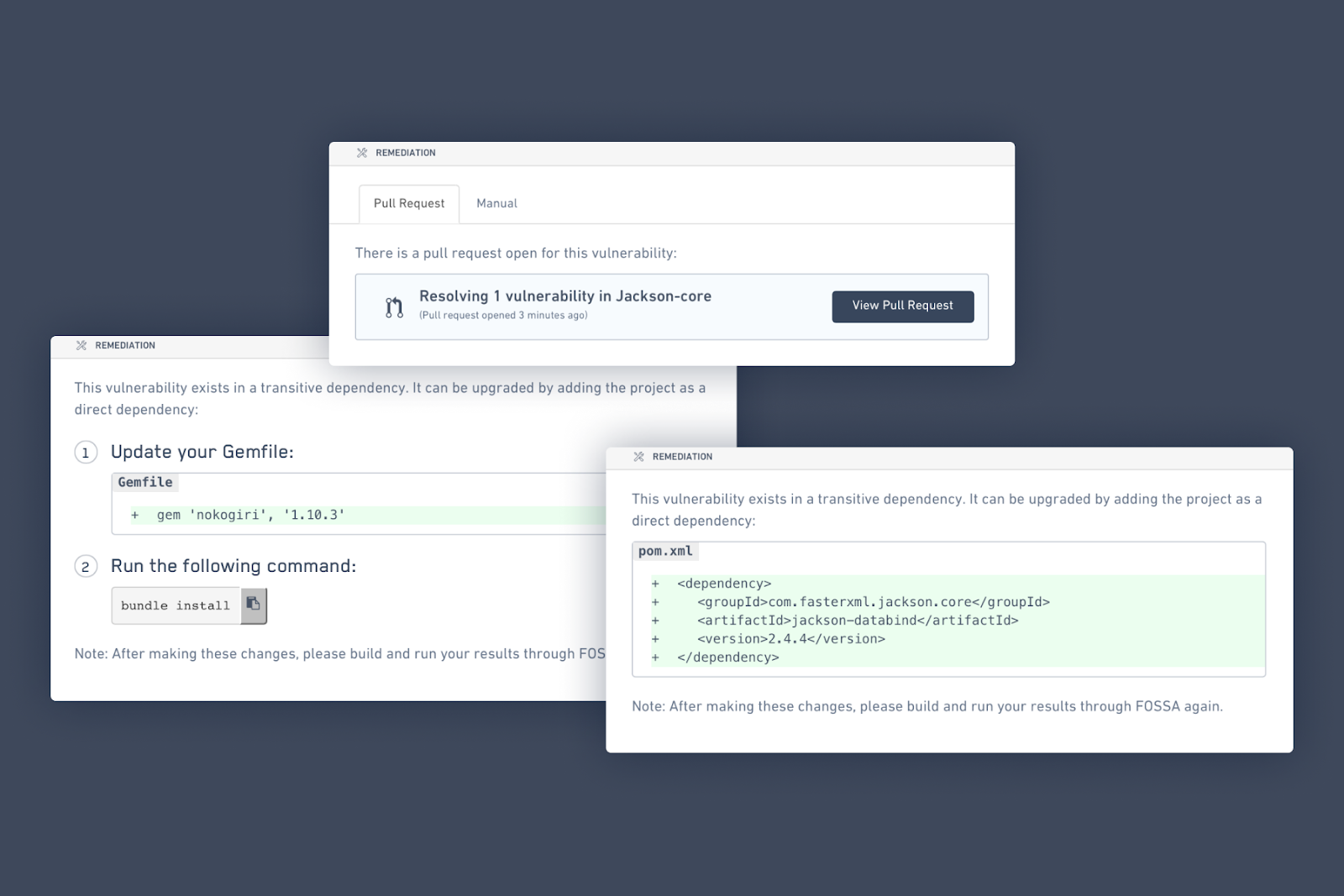
Software composition analysis doesn’t stop at identifying vulnerabilities. It also offers teams a range of guidance to assist remediation efforts. This starts with prioritization — the SCA tool will assign a CVSS score and severity rank to help organizations focus mitigation efforts. Additionally, while the specifics will vary depending on the SCA tool your organization uses, remediation guidance generally includes information on how best to upgrade the vulnerable OSS component. The screenshot below (taken from [FOSSA’s SCA tool](https://fossa.com/product/open-source-security-management#)) is an example of the sort of remediation guidance you might get from an SCA solution.
## SCA Makes Vulnerability Management More Efficient
There [have been](https://www.securitymagazine.com/articles/90182-the-cybersecurity-talent-gap-an-industry-crisis) [numerous accounts](https://www.forbes.com/sites/emilsayegh/2020/09/22/as-the-end-of-2020-approaches-the-cybersecurity-talent-drought-gets-worse/?sh=6ddae1845f86) in recent years detailing a shortage of qualified cybersecurity talent. With today’s ever-expanding attack surface and increasingly bold cybercriminals, this is a major problem. It’s also yet another reason why it’s so important for security teams to implement time-saving processes where and when possible. Software composition analysis does this in several key ways:
- It enables teams to shift left risk mitigation
- It enables teams to apply policies governing OSS vulnerability management at scale
**Shifting Left Risk Mitigation**
The later in the software development lifecycle you uncover vulnerabilities, the longer it takes (and the harder it is) to address them. Certain SCA tools integrate directly into CI/CD pipelines, which allows teams to continuously monitor code and prevent vulnerabilities from shipping to production in the first place. SCA can also integrate directly into the IDE environment, allowing for even more rapid vulnerability identification and remediation.
**Applying Policies at Scale**
Different teams abide by different policies when it comes to managing OSS vulnerabilities. Some might prefer to apply a default-deny posture to certain package versions, while others might want to simply flag them for further review. Of course, manually sifting through a listing of dependencies and vulnerabilities to inform go/no-go decisions takes hours upon hours. Software composition analysis automates this important process by enabling stakeholders to filter, approve/deny, and flag specific vulnerabilities and packages so they can enforce an optimal risk posture at scale.
## Software Composition Analysis and OSS Vulnerabilities: The Bottom Line
As the use of open source software has skyrocketed in recent years, so, too, has the importance of controlling OSS license compliance, code quality, and security risks. Software composition analysis (SCA) helps organizations address these concerns by identifying and analyzing dependencies and supporting remediation of any issues.
And when it comes to mitigating the specific risk posed by vulnerabilities in open source code, SCA offers organizations a powerful solution to efficiently and effectively understand and address potential threats.
For more information on software composition analysis, check out our blog: [The Future of Software Composition Analysis, Featuring Forrester](https://fossa.com/blog/future-software-composition-analysis-featuring-forrester.md).
## Related resources
- [Comparing Declared and Discovered OSS Licenses](https://fossa.com/blog/comparing-declared-discovered-oss-licenses.md): Organizations are successfully generating SBOMs for security, regulatory compliance, and business reasons, but struggle with their distribution.
- [Managing OSS License Compliance Risks in Commercial Software Licensing Agreements, Featuring Jim Markwith](https://fossa.com/blog/managing-oss-license-compliance-risks-commercial-software-licensing-agreements.md): Explore the evolution of open source software license compliance risks and best practices in commercial software agreements.
- [Q and A: Heather Meeker on Hot Topics in OSS License Compliance](https://fossa.com/blog/q-a-heather-meeker-hot-topics-oss-license-compliance.md): A discussion with Heather Meeker on pressing issues related to open source software license compliance, featuring key Q and A highlights from a recent webinar.
- [How OSS Conquered the World: Insight from Veteran Developers](https://fossa.com/blog/how-oss-conquered-world-insight-veteran-developers.md): FOSSA staff engineer Konstantin Gredeskoul and Oxide Computer Company's co-founder Bryan Cantrill discuss the development and impact of open source software in an informative and entertaining podcast.
- [Creating a Comprehensive 3rd-Party Package License Policy for OSS](https://fossa.com/blog/creating-a-comprehensive-third-party-package-license-policy.md): Learn how to create a comprehensive third-party package license policy, a vital element for companies engaging with open source software and ensuring compliance across various licenses.
## Source
Canonical page: https://fossa.com/blog/how-sca-helps-manage-oss-vulnerabilities/